
Fraction and Whole Number Calculator
Type a whole number, a fraction such as 3/4 or a mixed number such as 2 1/3 in each box, choose an operation, and the calculator shows how to get the answer step by step — writing the whole number as a fraction, finding a common denominator or flipping the divisor, then simplifying to lowest terms and a mixed number.
- Free to use
- No sign-up
- Runs in your browser
Quick answer
Use this whole number and fraction calculator to add, subtract, multiply, divide, or simplify whole numbers, fractions, and mixed numbers. It rewrites whole numbers over 1, converts mixed numbers to improper fractions, shows each step, and reduces the answer. To convert a fraction to a whole number, the numerator must divide evenly by the denominator, such as 12/4 = 3.
Fraction and whole number calculator
Examples: 7, 3/8, 1 1/2, -2 2/3. Exact fractions; decimals rounded to six places when needed. Up to 100 digits per integer part.
Fractions & Whole Numbers Worksheets
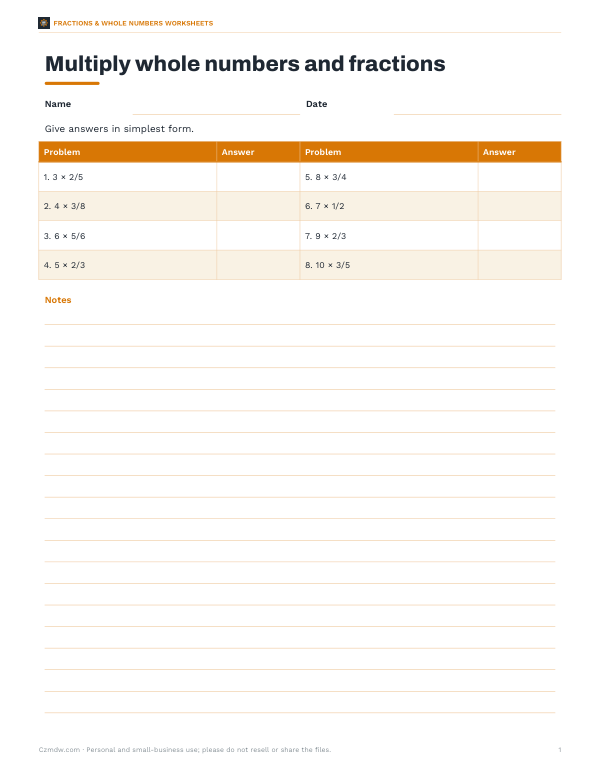
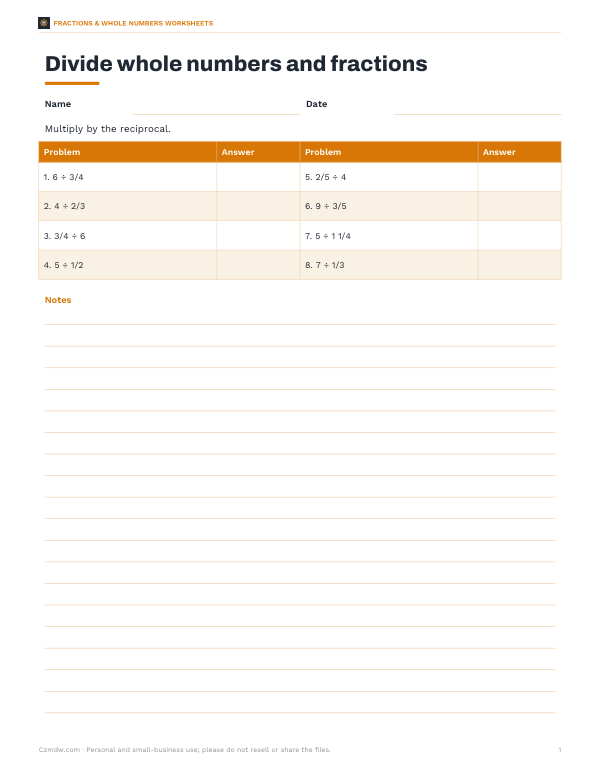
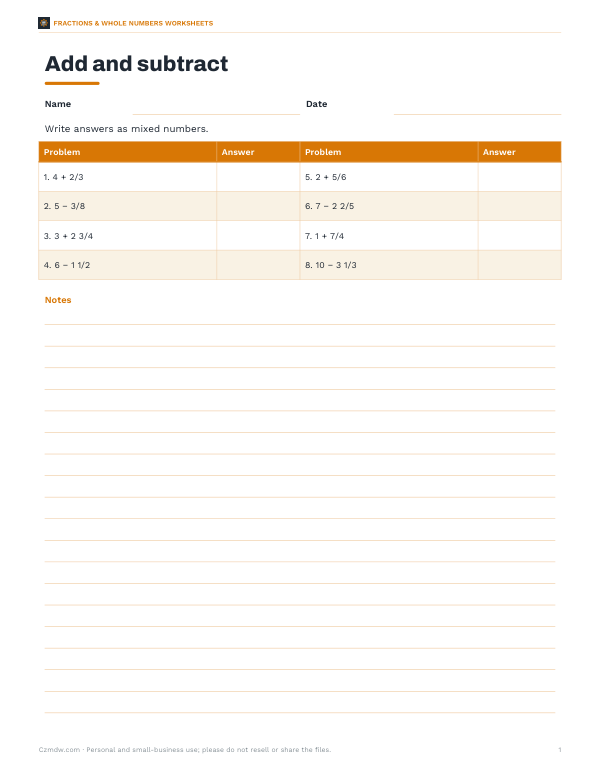
Four PDFs (24 practice questions with answers and a rules card), three editable Word worksheets, and README. PDFs are also free individually below; the $3 ZIP adds the editable worksheets and one-download convenience.
Printable worksheets with answer keys for multiplying, dividing, adding and subtracting whole numbers and fractions, plus a fraction rules reference card.
- Multiplication (PDF, DOCX)
- Division (PDF, DOCX)
- Add and subtract (PDF, DOCX)
- Rules card (PDF)
Formats: PDF, DOCX. Instant download after payment (link valid 72 hours, up to 5 downloads). AI-assisted: the templates were drafted with AI help and reviewed and laid out before publishing.
$3.00 USD, one-time 4 PDFs + 3 DOCX + README
- Instant download
- 7-day refund
- Secure checkout by Stripe
7-day money-back guarantee. Full refund within 7 days of purchase, even after you download.
Free sample: Add Subtract Whole Fraction (PDF, 52 KB)
Full refund within 7 days — see the refund policy and license.
Free printables
Single sheets you can print right now, no sign-up. The full pack adds every sheet in one download plus the editable files.
 Printable Fractions and Whole Numbers Rules Card
Whole number and fraction examples
Use these examples to choose the right entry and check what kind of answer to expect.
| Need | Enter | Key step | Result |
|---|---|---|---|
| Whole as fraction | 7 | 7/1 | 7 |
| Fraction to whole | 12/4 | 12 ÷ 4 | 3 |
| Fraction to mixed number | 7/4 | 1 remainder 3 | 1 3/4 |
| Add whole and fraction | 4 + 2/3 | 4/1 + 2/3 | 4 2/3 |
| Subtract from whole | 5 − 3/8 | 40/8 − 3/8 | 4 5/8 |
| Multiply by fraction | 5 × 2/3 | 10/3 | 3 1/3 |
| Divide by fraction | 6 ÷ 3/4 | 6/1 × 4/3 | 8 |
| Mixed number input | 2 1/2 × 2 | 5/2 × 2/1 | 5 |
Whole numbers are fractions too
The key idea behind every calculation with whole numbers and fractions is that any whole number can be written as a fraction with a denominator of 1: 5 = 5/1, and 12 = 12/1. Once both numbers are fractions, the ordinary fraction rules apply. Mixed numbers such as 2¾ are first turned into improper fractions: multiply the whole number by the denominator and add the numerator, so 2¾ = (2 × 4 + 3)/4 = 11/4.
Multiplying a whole number by a fraction
Multiply the whole number by the numerator and keep the denominator: 5 × 2/3 = 10/3 = 3⅓. Think of it as five lots of two-thirds. With a mixed number, convert first: 5 × 2¾ = 5/1 × 11/4 = 55/4 = 13¾. You can simplify before multiplying when a whole number and a denominator share a factor — 6 × 5/8 becomes 3 × 5/4 = 15/4 = 3¾ after dividing 6 and 8 by 2.
Dividing with whole numbers and fractions
| Problem | Method | Answer |
|---|---|---|
| 6 ÷ 3/4 | 6/1 × 4/3 = 24/3 | 8 |
| 3/4 ÷ 6 | 3/4 × 1/6 = 3/24 | 1/8 |
| 5 ÷ 1 1/4 | 5/1 × 4/5 = 20/5 | 4 |
| 2 1/2 ÷ 2 | 5/2 × 1/2 | 5/4 = 1 1/4 |
To divide by a fraction, multiply by its reciprocal — flip the second fraction upside down. Dividing a whole number by a fraction smaller than 1 gives a bigger answer: 6 ÷ ¾ = 8 means eight three-quarter pieces fit into 6. Dividing a fraction by a whole number makes it smaller: ¾ ÷ 6 = ⅛.
Adding and subtracting
To add a whole number and a fraction, you can simply write them together as a mixed number: 4 + ⅔ = 4⅔. For mixed numbers, add the whole parts and the fraction parts separately, or convert everything to improper fractions over a common denominator: 3 + 2¾ = 5¾. Subtracting a fraction from a whole number needs borrowing: 5 − ⅜ = 4 + 8/8 − 3/8 = 4⅝. The calculator uses the common-denominator method so every step is visible.
Worked example: a recipe
A recipe for 4 people uses 2¾ cups of flour, and you want to make it five times for a bake sale. The calculator shows 5 × 2¾: write 5 as 5/1, convert 2¾ to 11/4, multiply to get 55/4, and turn that into the mixed number 13¾ cups — 13.75 as a decimal. To split a 6-foot board into pieces ¾ foot long, 6 ÷ ¾ = 8 pieces.
Simplifying the answer
Answers are given in lowest terms by dividing the numerator and denominator by their greatest common factor: 12/16 becomes 3/4 after dividing by 4. Improper fractions (numerator larger than the denominator) are also shown as mixed numbers, which are easier to picture in everyday measurements such as 3¾ inches or 1½ hours. The decimal is useful for calculators, spreadsheets and money.
Negative numbers
The calculator accepts negative whole numbers, fractions and mixed numbers, such as −3 or −2 1/2. The usual sign rules apply: multiplying or dividing two numbers with the same sign gives a positive answer; different signs give a negative answer. For −2 1/2, the whole mixed number is negative: −(2 + ½) = −5/2.
Common mistakes
- Multiplying both the numerator and denominator by the whole number — 3 × 2/5 is 6/5, not 6/15.
- Forgetting to convert mixed numbers before multiplying or dividing: 2½ × 2 is 5, not 4½.
- Flipping the wrong fraction when dividing — only the divisor (the second number) is flipped.
- Adding denominators: ½ + ⅓ is 5/6, not 2/5.
- Leaving an answer unsimplified when the question asks for lowest terms.
Practice ideas
Try predicting whether the answer will be bigger or smaller than the whole number before calculating, then check with the tool. Use real measurements — cups, inches, hours — so the answers make sense. The paid practice pack includes worksheets with answer keys for each operation.
Why multiplying by a fraction can make a number smaller
Many students expect multiplication to make numbers bigger, so 8 × ¾ = 6 can feel surprising. Multiplying by a fraction less than 1 means taking part of the number — three-quarters of 8 is 6. Multiplying by a fraction greater than 1, such as 5/4, makes the number bigger: 8 × 5/4 = 10. In the same way, dividing by a fraction less than 1 makes the answer bigger, because you are asking how many small pieces fit into the number. Predicting “bigger or smaller” before calculating is a quick check that catches most mistakes.
Picturing the calculation
Area models and number lines make these calculations concrete. To show 3 × ⅖, draw three bars, each split into fifths, and shade two fifths of each: six fifths are shaded, which is 1⅕. To show 2 ÷ ¼, draw two whole bars split into quarters and count the quarters: there are eight. Measuring cups, rulers and clock faces are everyday versions of the same models, and they help children connect the written steps with real quantities.
Privacy
Everything runs in your browser; nothing you type is stored or sent anywhere.
Frequently asked questions
Can this calculator convert a fraction to a whole number?
Yes, if the fraction is equal to an integer. For example, 12/4 becomes 3; if it does not divide evenly, the calculator shows a simplified fraction or mixed number.
What should I type for a whole number with a fraction?
Type a mixed number with a space between the whole number and the fraction, such as 2 1/3. For a negative mixed number, type -2 1/3.
Why is my fraction answer not a whole number?
Only fractions with a numerator that is evenly divisible by the denominator simplify to whole numbers. Otherwise, the exact answer remains a fraction or mixed number.
How do you multiply a whole number by a fraction?
Multiply the whole number by the numerator and keep the denominator, then simplify.
How do you divide a whole number by a fraction?
Multiply the whole number by the reciprocal of the fraction.
How do I write a whole number as a fraction?
Put it over 1: 7 = 7/1.
How do I enter a mixed number?
Type the whole number, a space, then the fraction: 2 3/4.
What is 5 × 2 3/4?
13 3/4 (13.75).
Is my data stored?
No, it runs in your browser.